Why Midjourney and ChatGPT Fail at Amazon Product Photography (And What Dedicated E-Commerce AI Does Differently)
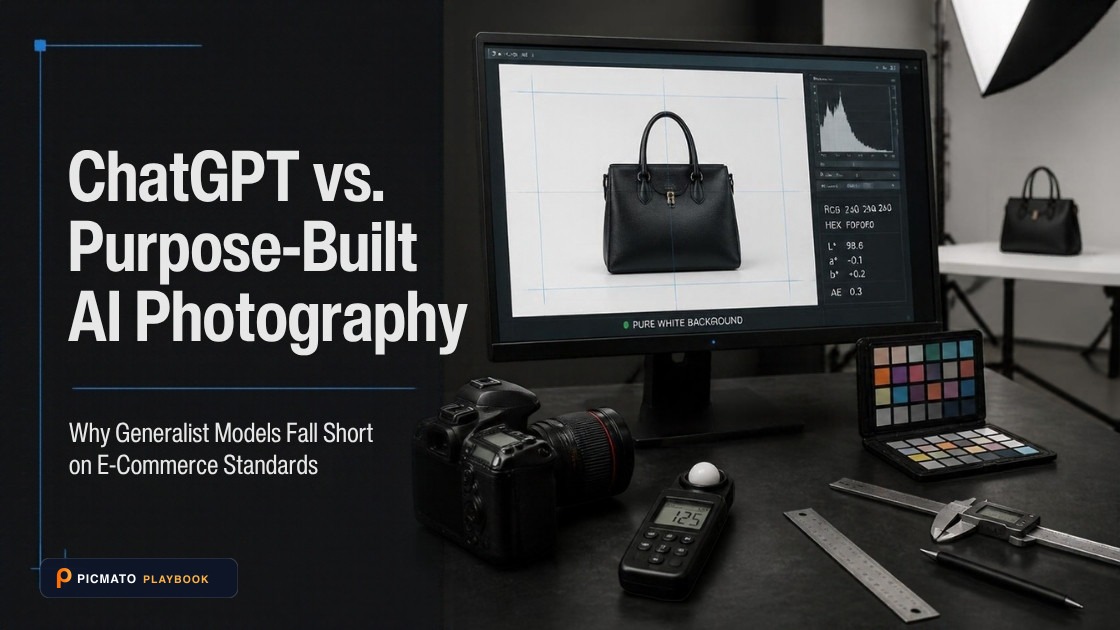
General diffusion models alter product geometry and hallucinate labels, while dedicated e-commerce workflows preserve authentic goods.
With generative AI expanding rapidly, many e-commerce sellers attempt to generate their Amazon product photos using general consumer tools like Midjourney, DALL-E, or ChatGPT. The initial results look striking, but sellers quickly hit fundamental technical barriers when uploading to Seller Central.
General AI models are trained to produce artistic fantasy visuals, not accurate commercial product photography. They distort product geometry, hallucinate text, and struggle with pure white background specifications. Here is why purpose-built e-commerce image workflows differ from raw prompt generators.
Create listing images from your product photos
Paste your Amazon, Flipkart, Walmart, or Meesho product link or upload phone shots. Picmato recommends listing image templates tailored to your product. Review the plan and choose which images to generate; a nine-image plan does not guarantee nine finished images or nine visible gallery slots. AI renderers do not guarantee an exact RGB value, so check with a color picker before uploading.
The appeal and immediate pitfall of general diffusion models
Prompting 'cosmetic serum bottle on white marble with sunlight' into a general diffusion model yields beautiful imagery within seconds. The problem arises when you compare the output with the physical item in your warehouse.
Diffusion models generate new pixels from random latent noise. They do not know what your real bottle looks like. They redraw the pump, alter the glass proportions, and replace your actual brand logo with gibberish lettering, creating an image of an item you do not manufacture.
The Pure White background failure: why 255/255/255 RGB requires dedicated segmentation
Amazon main images require a pure white background (RGB 255, 255, 255). General generative models generate continuous gradients and soft shadows, resulting in off-white (RGB 250, 248, 252) backgrounds or faint vignetting.
Uploading an off-white image triggers Amazon's automated quality filter, resulting in listing suppression. Dedicated e-commerce tools use precision edge segmentation and alpha matte compositing to ensure that background pixels hit true RGB values without halo artifacts.
Product geometry, packaging fidelity, and logo hallucination
In commercial e-commerce, product geometry is non-negotiable. Barcodes, regulatory symbols, ingredient lists, and typography must remain identical to the physical packaging to comply with consumer protection regulations.
General models treat typography as decorative patterns, hallucinating illegible glyphs. Specialized e-commerce AI models isolate the merchant's real photograph as an immutable base layer, generating contextual lighting and shadows around the genuine product rather than fabricating it.
| Technical Capability | General Diffusion Models (ChatGPT, Midjourney) | Dedicated E-Commerce AI Workflows |
|---|---|---|
| Product Integrity | Fabricates new geometry; alters cap, ports, and packaging | Preserves seller's real base photo; zero shape modification |
| Label & Typography | Hallucinates nonsense text and alters brand logos | Transcribes or preserves authentic label typography perfectly |
| Pure White Background | Produces off-white or gray gradients (RGB 245-252) | Applies clean studio compositing targeted to pure white |
| Aspect Ratios & Zoom | Arbitrary creative dimensions; lacks zoom validation | Exports standardized 1:1 square masters at 1K, 2K, or 4K resolution |
Consistent lighting and multi-slot catalog coherence
A successful Amazon gallery requires visual continuity across all 7 to 9 slots. When you re-prompt a general AI model for multiple images, each generation adopts different lighting directions, color temperatures, and scale ratios.
Dedicated e-commerce workflows maintain consistent color balancing and shadow direction across your entire listing set, presenting a professional brand experience rather than a collection of mismatched images.
Aspect ratios, export standards, and marketplace-ready metadata
E-commerce platforms demand exact square framing and clean file formatting. General generators often output rectangular crops that require manual cropping, often cutting off product edges.
Dedicated tools deliver production-ready square masters designed specifically for Amazon, Walmart, and regional e-commerce catalog requirements.
Technical comparison checklist for sellers evaluating AI tools
Evaluate these technical criteria before using an AI generation tool for commercial listings.
- Does the tool preserve your exact packaging photograph or regenerate new pixels?
- Can the tool export verifiable white backgrounds without gray cast?
- Are logos, barcodes, and ingredient panels retained without distortion?
- Does the system generate a cohesive set of diverse slot purposes or single random angles?
- Are exported resolutions sharp enough to support Amazon's high-resolution detail page zoom?
Where can Picmato help, and what must you still verify?
Picmato recommends listing image templates tailored to your product. A nine-image plan describes the planned main image and eight further image purposes based on your listing context; it does not promise nine finished images or nine visible Amazon gallery slots. Review the available plan and choose which images to generate.
The main-image brief is directed to a plain white studio background. AI renderers do not guarantee an exact RGB value; inspect the exported file with a color picker before uploading. Check the product shape, sold quantity, dimensions, every rendered word and any depicted accessories against your own evidence.
Use original packaging photographs for label details, identifiers, warnings and authorized marks. Picmato does not check marketplace or legal compliance and does not verify a translation. This guide does not establish successful URL imports from every Amazon country domain. Use your own product photos when an import is unavailable.
Frequently asked questions
Can I use ChatGPT or Midjourney to generate my Amazon main image directly?
Amazon policies require main images to display the exact product being shipped. Generating a synthetic product from scratch creates visual differences that mislead buyers and violate catalog rules. The compliant approach is using a real base photograph of your product and applying specialized studio background tools.
Why do general generative AI tools warp text and logos?
General diffusion models are probabilistic neural networks that predict pixel patterns based on training associations. They do not possess a concept of text spelling or vector logos, which causes them to warp typography into pseudo-alphabetic shapes.
How do dedicated e-commerce AI platforms keep products authentic?
Specialized platforms use computer vision segmentation to isolate the authentic photographed product. They preserve the original product pixels intact while generating contextual lifestyle backgrounds, softbox lighting, and realistic contact shadows around the genuine merchandise.