SFDA Product Labels in Listing Images: What Saudi Rules Say About Labels, Claims and Ads
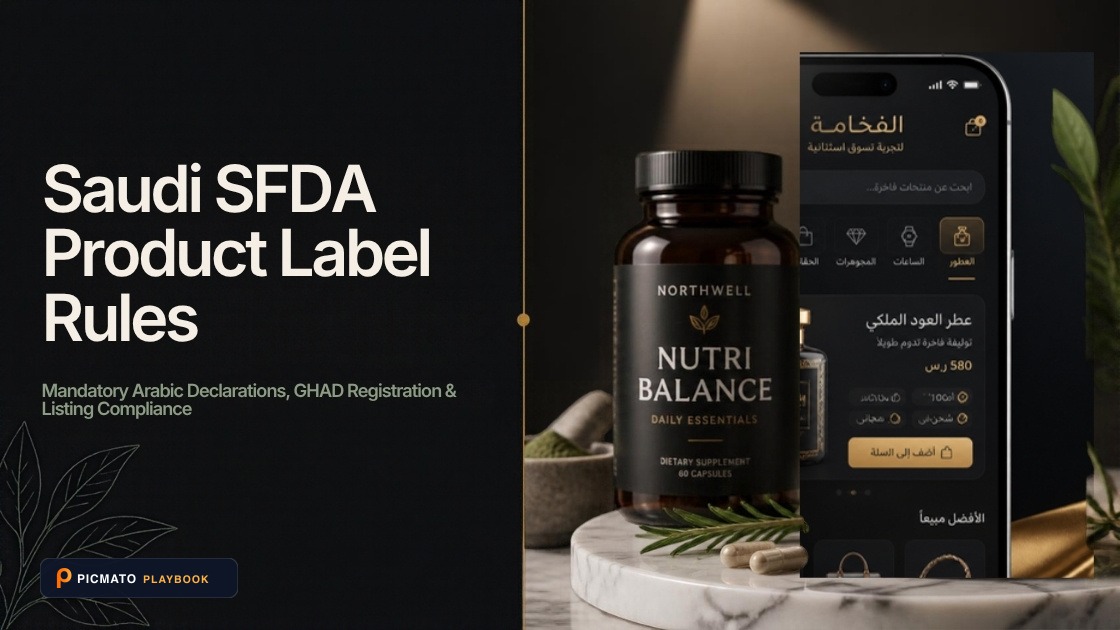
The Saudi Food and Drug Authority (SFDA) regulates products such as food, drugs, medical devices and cosmetics in Saudi Arabia. Its rules cover what the physical label must show, what claims a product may make, and, for cosmetics, how the product may be advertised. They do not set marketplace image specs. This guide covers what your pack photos and feature graphics should and should not show when you list SFDA-regulated products on Amazon.sa or Noon.
We checked SFDA's FAQ on English-only food labels, its cosmetics FAQ on label compliance, the English translation of the Implementing Regulation of the Cosmetic Products Law, the SFDA General Rules for Products Claim and SFDA's user guide for cosmetic services in the Ghad system. The pages were checked on 29 October 2026, and this guide is due for review by 29 January 2027. The regulation's English text is marked as a draft translation, and SFDA says the Arabic original prevails. We did not read SASO 1953 or the GSO standards it relies on, and Amazon.sa's image-policy page was not publicly readable. This is a preparation guide, not legal advice.
Create listing images from your product photos
Paste your Amazon, Flipkart, Walmart, or Meesho product link or upload phone shots. Picmato recommends listing image templates tailored to your product. Review the plan and choose which images to generate; a nine-image plan does not guarantee nine finished images or nine visible gallery slots. AI renderers do not guarantee an exact RGB value, so check with a color picker before uploading.
Where do listing images fit in SFDA rules?#
SFDA's General Rules for Products Claim define a claim as any message or representation, "including pictorial, graphic or symbolic representation", that states or implies a product has particular characteristics. An image on your listing can therefore carry a claim, even when the words are only in the picture.
For cosmetics, the Implementing Regulation defines an advertisement as any written, heard, visible or other statement that aims to promote, sell or market the product. Whether a marketplace image counts is a question for your adviser; a cautious approach is to treat the advertising controls as applying.
Article 21 says cosmetic products may not be advertised or promoted before they are listed with SFDA. Listing applications, which SFDA calls marketing notifications, are covered in its Ghad system user guide.
| Topic | SFDA source checked | What it says | Image action |
|---|---|---|---|
| Prepackaged food label | SFDA FAQ citing SFDA.FD/GSO 9 | Labeling and explanatory statements in Arabic; any other language alongside and identical | Photograph the final Arabic label on the pack you ship |
| Cosmetic label data | Implementing Regulation, Article 11 | Lists the data each cosmetic product must carry | Show the real label panel; never retype or rebuild it |
| Cosmetic advertising | Implementing Regulation, Article 21 circular | Arabic language, no misleading images, no SFDA name or logo | Match every image to the listed product |
| Product claims | SFDA General Rules for Products Claim | Claims include pictures; cosmetics may not carry medical claims | Check badges, icons and before-and-after frames |
What must cosmetic and food labels show?#
Article 11 of the cosmetics Implementing Regulation lists the data each cosmetic product must carry. It adds that SFDA specifies which of that data must be written in Arabic. SFDA's cosmetics FAQ says label compliance can be ensured by implementing SASO 1953, the cosmetic product safety regulation, so use that standard or your regulatory adviser for the exact language split.
For prepackaged food, SFDA's FAQ quotes SFDA.FD/GSO 9: labeling and explanatory statements must be in Arabic, any other language must sit alongside the Arabic, and information in the other language must be identical to the Arabic. Do not extend that food rule to cosmetics or devices; check the rule for your product classification.
- Product name and trade name, with the factory, manufacturer and their addresses
- Product validity
- Special warnings or cautions, including for professional use
- Function and method of use, unless clear from the presentation
- List of components
- Production date and batch number, or one of them
- Size or net weight
- Country of origin
- Storage instructions
Which claims and marks should stay out of your images?#
The cosmetics advertising controls in the Article 21 circular say an advertisement must not contain anything contrary to Islamic law and public morals. Its information must be reliable, accurate, honest and provable. It must not carry written information, images or scenes that mislead, including a claim that the product contains components it does not. The name or logo of SFDA, or of any other regulatory authority, must not be used directly or indirectly. The product image and data must match those of the product listed with SFDA, and Arabic is the language of the advertisement, with other languages allowed if they conform to the Arabic.
SFDA's claims guidance says cosmetics should not carry medicinal or therapeutic claims or be presented as treating or preventing disease. Graphics that imply medical use count as medical claims. For food, it lists claims that are not allowed, including a specific percentage or amount of weight loss, recommendations by individual doctors, and claims to prevent, treat or cure a disease. For health products, it says a term such as "100% safe" is not permitted, and "clinically proven" should be avoided for health supplements.
How should you plan pack-photo slots in the gallery?#
The main image follows the marketplace's rules, not SFDA's. On Noon, for example, the seller help article says the primary image must show the product outside its packaging, so label photos belong in the additional images. Amazon.sa's image-policy page was not publicly readable in our check, so confirm its main-image rules in Seller Central.
Our working recommendation, not a marketplace or SFDA rule, is to give the label its own additional images: the Arabic label panel, the components list, and warnings and storage text. Photograph the pack intended for the Saudi market, leave printed dates and batch codes unedited, and check the text is legible on a phone.
Localizing packaging assets with AI studio workflows#
Picmato can generate lifestyle scenes around your product from packaging photos you upload. It does not check SFDA registration or labeling requirements and does not verify a translation. AI renderers can alter small printed text, so Arabic declarations, batch numbers and warnings should come from your own photographs of the physical pack. Compare every export with the real product before you list it.
All dimensions, RGB requirements, and technical guidelines in this playbook are verified directly against official 2026 seller portal specifications (Amazon Seller Central, Walmart Marketplace, Flipkart Seller Hub, and FSSAI standards).
Last reviewed for policy compliance: Oct 29, 2026
Frequently asked questions
Do cosmetics sold in Saudi Arabia need Arabic labels?
Article 11 of the Implementing Regulation of the Cosmetic Products Law lists the data each cosmetic product must carry and says SFDA specifies which data must be written in Arabic. SFDA's cosmetics FAQ points to SASO 1953 for label compliance. The regulation's advertising controls also make Arabic the language of cosmetic advertisements. Check SASO 1953 or a regulatory adviser for the exact items.
Can I use the SFDA logo on product images?
Not for cosmetics advertising. The controls in the Implementing Regulation of the Cosmetic Products Law say the name or logo of SFDA must not be used directly or indirectly in an advertisement, and the same applies to any other regulatory authority. Do not add an SFDA seal or approval badge to a listing image, even if the product is listed with SFDA.
Can a food label in Saudi Arabia be in English only?
No. SFDA's FAQ cites SFDA.FD/GSO 9, Labeling of Prepackaged Food Stuffs, which says labeling and explanatory statements must be in Arabic. Where another language is used, it must sit alongside the Arabic, and the information must be identical. For listing images, photograph the final label on the pack you sell in Saudi Arabia rather than overlaying translated text.
What is the Ghad system at SFDA?
Ghad is an SFDA electronic system. SFDA's user guide for cosmetic licensing and product services in Ghad covers cosmetic factory and warehouse licenses and applications to list cosmetic products, which SFDA calls marketing notifications. The cosmetics regulation says products may not be advertised or promoted before they are listed, so confirm the listing before you publish product images.
Can cosmetic product images make medical claims in Saudi Arabia?
No. SFDA's General Rules for Products Claim say cosmetics should not carry medicinal or therapeutic claims or be presented as treating or preventing disease. The guidance defines a claim to include pictorial and graphic representations, and it lists graphics that imply medical use as medical claims. Remove cure, heal or disease icons and wording from cosmetic listing images.
Sources & Reference Documentation
- SFDA: Is it allowed to write the food product label in English only?
- SFDA: Ensuring a cosmetic product label complies (FAQ citing SASO 1953)
- SFDA: Implementing Regulation of Cosmetic Products Law (English translation)
- SFDA: General Rules for Products Claim (2021)
- SFDA: User Guide for Cosmetic Licensing and Products Service in Ghad System
- noon Partners: Image Requirements and Rejection Reasons for the Seller SKU
Related on Picmato
Recommended Playbooks & Market Guides
Platform policies, image compliance documentation, and conversion frameworks.
Amazon Saudi Arabia Listing Images: Requirements, Arabic Labels, and Product Claims
Prepare Amazon Saudi Arabia images while distinguishing Arabic food labels, reviewed feature copy, Saber documents, and licensed quality marks.
Amazon UAE Listing Images: Requirements and Arabic-English Localization
Prepare Amazon UAE listing images with bilingual creative review, authentic product documents, and clear limits around conformity marks and labels.
Noon Product Image Requirements: File Specs, Primary Image Rules, and Rejection Reasons
Noon's published image rules for sellers: JPEG files up to 10 MB, at least 660 px wide, white primary backgrounds, framing margins and rejection reasons.