Amazon South Africa Listing Images: Requirements and Product Label Considerations
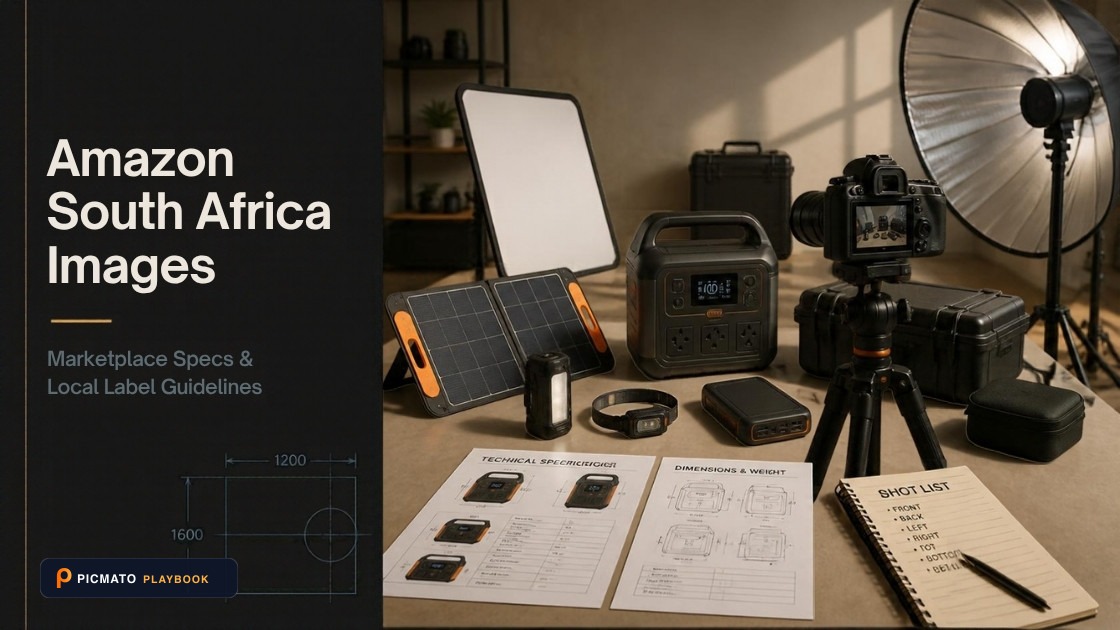
Align Amazon.co.za product images with accurate technical specifications and authentic labels.
For Amazon South Africa, verify image policy and product-document obligations separately. A precise photograph of the destination model is useful evidence, but it does not establish NRCS approval or an SABS certification. Do not add a familiar local logo to make an imported product look approved.
Checked on 19 October 2026; review by 19 January 2027. The local Amazon image-policy body was not publicly readable and the NRCS pages attempted here could not be fetched. This guide therefore gives a preparation workflow and explicit research limits rather than an unverified list of mandatory LOA categories.
Create listing images from your product photos
Paste your Amazon, Flipkart, Walmart, or Meesho product link or upload phone shots. Picmato recommends listing image templates tailored to your product. Review the plan and choose which images to generate; a nine-image plan does not guarantee nine finished images or nine visible gallery slots. AI renderers do not guarantee an exact RGB value, so check with a color picker before uploading.
Which Amazon image specifications should you check for South Africa?#
Check Product image requirements in the amazon.co.za Seller Central store and the style guide for your product category. The local help page did not expose its policy body in our public-source check on 19 October 2026. We cannot certify an exact local upload minimum or zoom threshold from that page. The linked Amazon.com guide is a reference with US scope, not proof of an identical local rule.
Our production recommendation is a sharp 2,000-pixel square master when your original photograph supports it. That is a working export target, not an Amazon mandate. Keep the full product visible, avoid inventing accessories, and check the destination requirements before cropping or exporting.
| Item to verify | Evidence and status | Practical action |
|---|---|---|
| Minimum upload size | Local policy body unavailable in this public check | Read the selected store’s current image requirements before upload |
| Zoom threshold | Separate from minimum upload size; not independently verified locally | Inspect the final pixel dimensions and live detail-page zoom |
| Export size and crop | Picmato recommendation, not a local requirement | Use a sharp 2,000-pixel square master where appropriate |
| Main and secondary content | Placement and category rules need local confirmation | Keep promotions, invented badges and unsupported claims out of the gallery |
What should you establish before showing an approval mark?#
Ask the manufacturer or importer which current compulsory specification, if any, applies to the exact model and which supporting authorization is required. Request the model identifier, issuing authority, applicable document and validity evidence before approving a conformity representation.
The current NRCS LOA workflow and category applicability were not independently verified in this check. Do not treat NRCS documentation and an SABS certification mark as interchangeable. This article makes no claim that either is required for every electrical or electronic product, or that a label close-up replaces a submission.
| Question for the supplier | Evidence to request | Gallery action |
|---|---|---|
| Which model is actually shipped? | Model identifier and destination specifications | Photograph that exact version |
| Does a compulsory specification apply? | Current official scope and relevant model documents | Resolve the obligation before implying approval |
| Is a displayed mark authorized? | Applicable license or authorization | Use genuine label photos only |
| What performance can you claim? | Manufacturer-approved specification and test context | Keep units and conditions with the claim |
How should electrical-product specifications be presented?#
Our recommendation is to distinguish power, energy, capacity and compatibility rather than compressing them into an unexplained number. State only values supplied by the seller’s approved technical sheet, with the conditions that make them meaningful. Do not infer compatibility from a plug drawing alone.
For a backup-power product, distinguish a documented continuous output from a surge rating and a battery’s energy from a runtime claim. This is a creative accuracy example, not evidence that such products are current bestsellers or that a particular infographic reduces returns.
How would you prepare a documented power-product gallery?#
Suppose a seller provides an approved specification sheet and photographs of a particular unit. Leave missing values blank in the brief rather than asking a generator to fill them.
This is an illustrative preparation exercise, not a tested seller result or certification example. Replace every placeholder with your own measured and documented product facts.
| Asset | Evidence to supply | Review before use |
|---|---|---|
| Product and connection photo | Actual unit, ports and cable supplied | Do not substitute a different regional plug |
| Output specification | Documented continuous/surge values and conditions | Keep unlike ratings distinct |
| Capacity information | Documented quantity and unit | Do not invent a runtime from capacity alone |
| Label close-up | Real model and rating plate | Retain identifiers and authorized marks without redrawing |
Can you transfer Takealot or other marketplace creative?#
Check the destination requirements before reusing an asset. This article does not establish Takealot aspect ratios, margins or overlay permissions, and does not present a comparison without direct evidence. Reuse the product facts only when the destination product and included contents match.
Keep an editable source file, an original pack photograph and a dated record of your policy check. Treat a different accessory bundle or plug version as a new asset-review task even if the product title looks similar.
What should you check before uploading?#
Treat this as an editorial preparation checklist. Confirm the actual marketplace requirements and product obligations separately; a good-looking gallery is not evidence of product certification.
- Confirm the store, exact product variant, category and current image policy.
- Obtain model-specific product documents and verify current official scope.
- Keep power, energy and performance conditions distinct.
- Do not imply an NRCS approval or SABS mark without the applicable evidence.
- Check pixel dimensions, crop, readable text and the exported background color.
- Preview on a phone and desktop; inspect the live listing after upload.
Where can Picmato help, and what must you still verify?#
Picmato recommends listing image templates tailored to your product. A nine-image plan describes the planned main image and eight further image purposes; it does not promise nine finished images or nine visible Amazon gallery slots. Review the available plan and choose which images to generate.
The main-image brief is directed to a plain white studio background. AI renderers do not guarantee an exact RGB value; inspect the exported file with a color picker before uploading. Check the product shape, sold quantity, dimensions, every rendered word and any depicted accessories against your own evidence.
Use original packaging photographs for label details, identifiers, warnings and authorized marks. Picmato does not check marketplace or legal compliance and does not verify a translation. This guide does not establish successful URL imports from every Amazon country domain. Use your own product photos when an import is unavailable.
All dimensions, RGB requirements, and technical guidelines in this playbook are verified directly against official 2026 seller portal specifications (Amazon Seller Central, Walmart Marketplace, Flipkart Seller Hub, and FSSAI standards).
Last reviewed for policy compliance: Oct 19, 2026
Frequently asked questions
Does every Amazon.co.za electrical product need an SABS mark?
This guide does not establish that claim. Determine which current product rules apply and distinguish relevant regulatory documents from certification marks. Our NRCS source fetches did not allow independent verification of current scope. Ask the manufacturer or importer for model-specific official evidence before adding any approval representation to the listing.
Can a label photograph replace an NRCS submission?
Do not assume so. A photograph records what the product shows; a regulatory submission or authorization is a separate process. The current workflow was not independently verified here, so this article does not prescribe submission steps. Keep documentation matched to the exact model and use the relevant official instructions.
Should I use a power-station infographic with estimated runtime?
Only publish a runtime when the seller supplies evidence and the relevant conditions. Battery energy, output power and runtime are different measurements. Do not ask a generator to infer an unsupported number. Use a real label close-up and a specification slide based on approved product data, then review the destination image policy.
Sources & Reference Documentation
Recommended Playbooks & Market Guides
Platform policies, image compliance documentation, and conversion frameworks.
Amazon Global Selling: Listing Image Requirements Across 11 Marketplaces
Compare image preparation across 11 Amazon stores, with source limits, local label considerations, and a practical cross-border gallery workflow.
Amazon Listing Image Requirements, Explained
Read Amazon.com image-size guidance, distinguish upload and zoom targets, and prepare accurate main images and galleries with clear source limits.
Consumer Electronics & Appliance Listing Images: The Blueprint to Slashing Returns
Consumer electronics suffer from 15% to 22% return rates, with over 60% driven by 'No Defect Found' buyer confusion around size, ports, and missing cables. Here is the complete 2026 blueprint to design high-converting, return-slashing electronics image galleries across Amazon, Flipkart, and Walmart.