Amazon Australia Listing Images: Requirements and Local Label Considerations
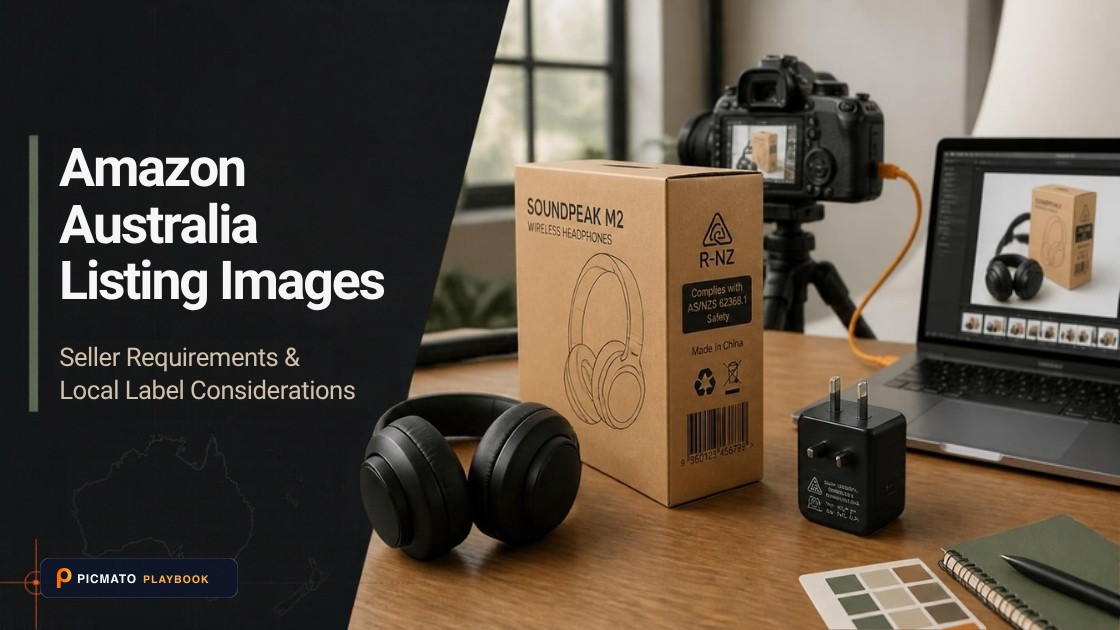
Review Amazon.com.au image guidelines alongside electrical safety and trade measurement details.
For Amazon Australia, verify the store’s image policy separately from the rules applying to your product’s label and advertising. Food-origin labeling and therapeutic-product claims need different evidence; neither is a universal instruction to add a logo or warning slide.
Checked on 19 October 2026; review by 19 January 2027. The local image help page was not publicly readable in this check. ACCC and TGA sources below support the qualified local considerations, not a claim that Picmato validates them.
Create listing images from your product photos
Paste your Amazon, Flipkart, Walmart, or Meesho product link or upload phone shots. Picmato recommends listing image templates tailored to your product. Review the plan and choose which images to generate; a nine-image plan does not guarantee nine finished images or nine visible gallery slots. AI renderers do not guarantee an exact RGB value, so check with a color picker before uploading.
Which Amazon image specifications should you check for Australia?#
Check Product image requirements in the amazon.com.au Seller Central store and the style guide for your product category. The local help page did not expose its policy body in our public-source check on 19 October 2026. We cannot certify an exact local upload minimum or zoom threshold from that page. The linked Amazon.com guide is a reference with US scope, not proof of an identical local rule.
Our production recommendation is a sharp 2,000-pixel square master when your original photograph supports it. That is a working export target, not an Amazon mandate. Keep the full product visible, avoid inventing accessories, and check the destination requirements before cropping or exporting.
| Item to verify | Evidence and status | Practical action |
|---|---|---|
| Minimum upload size | Local policy body unavailable in this public check | Read the selected store’s current image requirements before upload |
| Zoom threshold | Separate from minimum upload size; not independently verified locally | Inspect the final pixel dimensions and live detail-page zoom |
| Export size and crop | Picmato recommendation, not a local requirement | Use a sharp 2,000-pixel square master where appropriate |
| Main and secondary content | Placement and category rules need local confirmation | Keep promotions, invented badges and unsupported claims out of the gallery |
Which Australian origin labels should a food photograph show?#
ACCC’s Country of origin food labelling guidance distinguishes priority and non-priority foods and the place of production. The three-part label with a kangaroo is associated with priority food grown, produced or made in Australia. Imported food does not automatically qualify for that label.
Photograph the finalized retail pack for the actual product. If your food uses an origin statement rather than a kangaroo/bar-chart label, retain that statement instead of replacing it with an Australian-looking seal. Our recommendation is a legible pack photo, not a claim that ACCC mandates a dedicated Amazon gallery slot.
| Situation | Authority and scope | Asset decision |
|---|---|---|
| Priority food grown, produced or made in Australia | ACCC origin-label framework | Photograph the authorized final label |
| Imported or non-priority food | Different label formats can apply | Do not invent a kangaroo mark |
| Non-food product | The food-origin standard does not establish its image requirements | Verify any origin representation separately |
Can therapeutic claims or testimonials appear in Australian creative?#
TGA’s general advertising guidance requires substantiated, balanced claims consistent with the applicable ARTG entry or relevant exemption. This applies to therapeutic goods that may be advertised to the public; do not treat every skincare or wellness item as having the same classification.
TGA’s testimonial guidance is conditional rather than a blanket ban. That does not establish permission to place a testimonial in an Amazon image. Review the product classification, claim evidence and destination placement separately. ACCC’s misleading-claims guidance also makes the overall visual impression relevant.
How would you prepare an imported food pack for Australia?#
Use this hypothetical example for an imported jar. Supply the real pack, an approved origin statement and an ingredient/claim sheet before choosing gallery assets.
This is an illustrative preparation exercise, not a tested seller result or certification example. Replace every placeholder with your own measured and documented product facts.
| Asset | Evidence to supply | Review before use |
|---|---|---|
| Main photograph | Exact jar, lid and quantity shipped | Keep product identity unchanged |
| Pack detail | Final Australian-sale label | Retain genuine origin wording; no invented local badge |
| Feature callout | Evidence supporting the proposed feature | Remove therapeutic implications without substantiation |
| Dimension slide | Seller measurements | Metric units are our presentation recommendation, not a blanket image law |
What should you check before uploading?#
Treat this as an editorial preparation checklist. Confirm the actual marketplace requirements and product obligations separately; a good-looking gallery is not evidence of product certification.
- Confirm the store, exact product variant, category and current image policy.
- Check origin wording against the finalized retail pack.
- Review product classification and substantiation before using health-related copy.
- Check pixel dimensions, crop, readable text and the exported background color.
- Preview on a phone and desktop; inspect the live listing after upload.
Where can Picmato help, and what must you still verify?#
Picmato recommends listing image templates tailored to your product. A nine-image plan describes the planned main image and eight further image purposes; it does not promise nine finished images or nine visible Amazon gallery slots. Review the available plan and choose which images to generate.
The main-image brief is directed to a plain white studio background. AI renderers do not guarantee an exact RGB value; inspect the exported file with a color picker before uploading. Check the product shape, sold quantity, dimensions, every rendered word and any depicted accessories against your own evidence.
Use original packaging photographs for label details, identifiers, warnings and authorized marks. Picmato does not check marketplace or legal compliance and does not verify a translation. This guide does not establish successful URL imports from every Amazon country domain. Use your own product photos when an import is unavailable.
All dimensions, RGB requirements, and technical guidelines in this playbook are verified directly against official 2026 seller portal specifications (Amazon Seller Central, Walmart Marketplace, Flipkart Seller Hub, and FSSAI standards).
Last reviewed for policy compliance: Oct 19, 2026
Frequently asked questions
Must every Amazon Australia image use a kangaroo origin logo?
No. ACCC’s food-origin guidance uses different formats depending on the food and its origin. A kangaroo label is not a generic badge for anything sold in Australia, and the food-label standard does not establish a universal gallery-image rule. Photograph the appropriate genuine pack rather than creating a new certification-looking graphic.
Are all therapeutic claims and testimonials prohibited?
No blanket statement is appropriate. TGA requires substantiation and imposes conditions on therapeutic advertising and testimonials. Some products and claims cannot be advertised in the same way as others. Amazon placement policies are a separate check, so a claim meeting a TGA condition is not automatically suitable for an Amazon gallery.
What image size should I export for Australia?
Check the current Amazon Australia requirements for your category. We could not read the local policy body in this public check. A sharp 2,000-pixel square master is our production recommendation when the source supports it, not a verified Australian minimum or zoom threshold. Avoid enlarging a small photo and assuming it becomes more informative.
Sources & Reference Documentation
- Amazon AU: Product image requirements (help page access limited)
- Amazon.com: Product photos, photo requirements and zoom guidance
- ACCC: Country of origin food labelling
- ACCC: False or misleading claims
- TGA: General requirements for advertising therapeutic goods to the public
- TGA: Applying the Advertising Code rules, testimonials and endorsements
Recommended Playbooks & Market Guides
Platform policies, image compliance documentation, and conversion frameworks.
Amazon Global Selling: Listing Image Requirements Across 11 Marketplaces
Compare image preparation across 11 Amazon stores, with source limits, local label considerations, and a practical cross-border gallery workflow.
Amazon Listing Image Requirements, Explained
Read Amazon.com image-size guidance, distinguish upload and zoom targets, and prepare accurate main images and galleries with clear source limits.
Walmart Image Requirements: US vs Canada, Side by Side
Walmart's US and Canada image pages give different numbers, and Walmart's two Canada pages disagree with each other. Every spec side by side, with the page dates, plus one master file that passes all three.